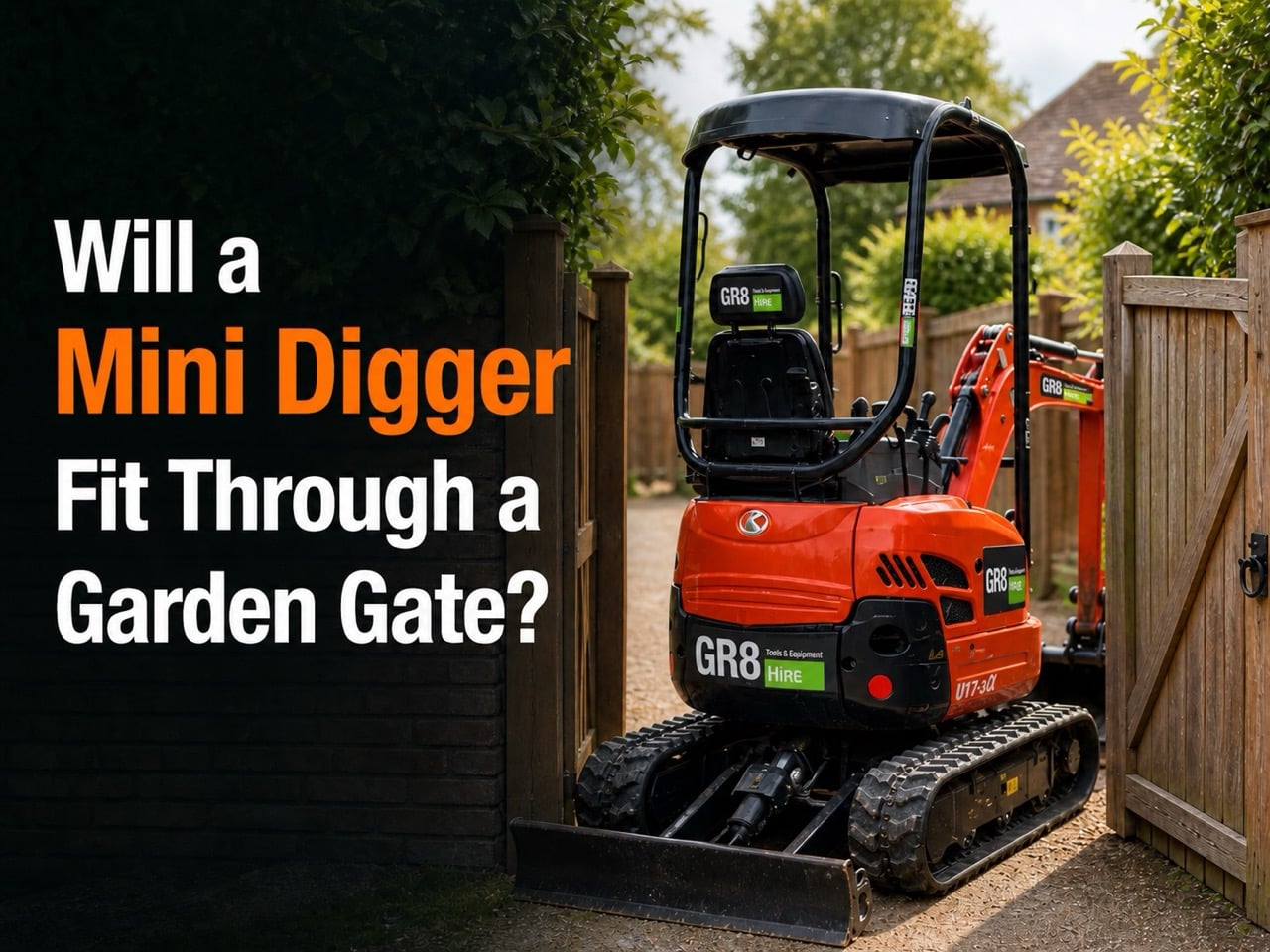

Yes, a mini digger can fit through many garden gates, but only if you choose the right machine and measure the full access route properly. For the tightest domestic access, you normally need a micro digger rather than a larger mini digger. GR8’s 0.75T Micro Digger has a minimum width of 700mm, while the 0.75T Mini Digger has a minimum width of 750mm.
The safest answer is simple: measure the narrowest point from the delivery area to the digging area, then choose the machine around that measurement. Do not rely on the gate width alone.
Mini digger garden gate widths at a glance
| Access width | Likely suitability | Suggested GR8 option |
|---|---|---|
| Under 700mm | A standard GR8 0.75T micro digger is unlikely to pass without changing the access. | Speak to GR8 before booking. |
| 700mm to 749mm | The 0.75T Micro Digger may be suitable, but the full route must be checked carefully. | 0.75T Micro Digger Hire |
| 750mm to 989mm | The 0.75T Mini Digger may also be an option, subject to turning room and surface conditions. | 0.75T Mini Digger Hire |
| 990mm to 1499mm | A 1.8 Ton Digger may be possible if the route and working area allow. | 1.8 Ton Digger Hire |
| 1500mm+ | Larger machines may be practical for bigger jobs, depending on the site. | 3 Ton Digger Hire |
Measure the whole route, not just the gate
A gate can look wide enough at first glance, but the usable opening is often smaller than expected. Hinges, latches, bolts, gate stops, uneven posts and raised thresholds can all reduce the clear space available.
You also need to measure what comes after the gate. A micro digger may pass through the opening but still struggle if there is a sharp turn, a narrow side path or a raised drain immediately inside the garden.
Check the full route for:
- The clear opening between gate posts.
- Hinges, handles, bolts and latches that stick into the opening.
- Side passages, alleyways and paths.
- Sharp turns between walls, fences, sheds or extensions.
- Steps, thresholds, slopes and changes in ground level.
- Drain covers, inspection chambers and uneven paving.
- Low branches, roof overhangs, guttering and cables.
- Soft ground, loose gravel, weak paving or wet lawns.
The narrowest point controls the machine choice. If the gate is 850mm wide but the side passage narrows to 690mm, the 690mm point is the real limit.
Micro digger or mini digger: what is the difference?
People often use “mini digger” to describe any small excavator, but for garden gate access the key term is usually “micro digger”. A micro digger is designed for restricted spaces where a standard mini digger would be too wide.
GR8’s 0.75T Micro Digger is the tight-access option with a minimum width of 700mm. It is suited to small garden excavation, trenches, landscaping, drainage and other domestic projects where space is limited.
The 0.75T Mini Digger has a minimum width of 750mm and offers another compact option where the access is slightly wider. It also has zero tail swing, which is useful when working close to walls, fences and buildings.
If access is wider, a 1.8 Ton Digger can be more productive for deeper trenches, driveways and heavier domestic excavation, but it needs a minimum width of 990mm and more room to move safely.
How much clearance should you allow?
A machine width and a gate width are not the same as practical working clearance. A 700mm machine through a 700mm gap leaves no margin for uneven posts, steering corrections, track movement or slight measurement errors. In real life, a little extra space is always better.
If your access is exactly on the limit, speak to GR8 before booking. It may still be possible, but the team will need to understand the route properly. Photos, measurements and a clear description can prevent delays or failed delivery.
Measure in millimetres, not rough estimates. “About three feet” is less useful than “the narrowest point is 735mm between the wall and fence post”.
What if the gate is too narrow?
If the access is too narrow, do not force the digger through. It can damage the gate, walls, fencing, paving or machine. Instead, consider whether the access can be improved safely.
Possible options include:
- Temporarily removing the gate.
- Removing a gate stop, latch or bolt that reduces the opening.
- Lifting a fence panel, if suitable and safe.
- Creating a temporary access point through a wider route.
- Using a smaller machine where available.
- Changing the method if machine access is not practical.
Always check the whole route again after changing the gate access. Removing a gate does not help if the side passage, path or turn is still too narrow.
Can a mini digger go through a garage?
Sometimes a compact digger can pass through a garage or outbuilding, but this needs careful planning. You must consider the door width, floor strength, threshold, ventilation, turning room, wall protection and whether the route is suitable for a tracked machine.
Do not drive a diesel-powered machine through enclosed living spaces. If the only route is through a garage, passageway or building, discuss it with GR8 before booking and provide photos of the access.
Will a micro digger damage the lawn?
A micro digger is much lighter than larger excavators, but it is still a tracked machine. On dry, firm ground it may leave minimal marking, but on wet lawns, clay soil or soft ground it can create ruts.
To reduce the risk of damage:
- Use ground protection boards where needed.
- Keep the travel route short and straight.
- Avoid sharp turns on grass.
- Clear obstacles before the machine arrives.
- Plan where the spoil will be placed.
- Do not overload soft areas with heavy soil piles.
If soil has to be moved from the back garden to the front of the property, consider Dumper Hire as well as the digger. This can reduce barrow work and help keep the dig area clearer.
What garden jobs can a micro digger do?
A narrow-access micro digger is useful for many back garden and domestic projects, including:
- Digging drainage trenches.
- Excavating for water pipes or ducting.
- Preparing patio and decking areas.
- Digging small foundation trenches.
- Levelling uneven gardens.
- Creating ponds and garden features.
- Removing old beds, borders and compacted soil.
- Digging out shed bases and garden room bases.
- Preparing ground before turfing or landscaping.
If you are deciding between different digger sizes, read GR8’s guide: When should you hire a mini digger and what size is right for your project?
When a micro digger may not be the best choice
A micro digger is excellent for tight access, but it is not always the fastest or most suitable machine. If you have wide access, deeper trenches, large quantities of spoil or heavy ground, a larger digger may complete the work more efficiently.
For example, a 0.75T micro digger may be perfect for a narrow side passage and a small drainage run. However, for a long driveway excavation or deeper footings with good access, a 1.8 Ton Digger or 3 Ton Digger could be the better choice.
The best machine is the one that balances access, digging depth, ground conditions, productivity and surface protection.
Check for services before digging in a garden
Even back gardens can contain underground services. Drainage runs, outbuilding supplies, garden lighting cables, water pipes and old utilities may be present. Front gardens and driveways are even more likely to contain services.
Before excavation, consider using CAT 4 Cable Locator Hire and Genny 4 Hire to help locate buried utilities. Where services are suspected, hand digging and careful exposure may be required before using the digger near them.
What to photograph before calling GR8
Photos help the hire team understand the access before recommending a machine. Before calling, take clear photos of:
- The gate from the outside and inside.
- The narrowest side passage or alleyway.
- Any tight turns.
- Steps, drains or raised thresholds.
- The lawn or surface the machine will travel over.
- The area to be dug.
- Where the spoil will go.
Send the measurements with the photos. This makes it much easier to decide whether the 0.75T Micro Digger, 0.75T Mini Digger or a larger machine is the right option.
Garden gate access checklist
- Measure the gate opening in millimetres.
- Check whether hinges, latches or bolts reduce the opening.
- Measure the full side path or passage.
- Check turns immediately after the gate.
- Look for steps, slopes, drains and loose surfaces.
- Check low branches, roof edges and overhead obstructions.
- Clear bins, pots, furniture and garden items.
- Decide whether a fence panel or gate can be safely removed if needed.
- Take photos before contacting GR8.
- Ask which machine best matches the measurements and job.
So, will a mini digger fit through your garden gate?
If the full access route is at least 700mm wide, GR8’s 0.75T Micro Digger may be suitable. If the route is at least 750mm wide, the 0.75T Mini Digger may also be an option. Wider access opens up larger machines such as the 1.8 Ton Digger.
Measure the access carefully, take photos and speak to GR8 before booking. View the full Digger Hire range or contact GR8 Tool Hire Cambridge for local help choosing the right machine.
FAQs
What is the narrowest mini digger GR8 hires?
GR8’s 0.75T Micro Digger has a minimum width of 700mm, making it suitable for many tight-access garden jobs.
Can a 700mm micro digger go through a 700mm gate?
It may be technically possible, but it leaves no useful clearance. Measure carefully and speak to GR8 before booking if the access is exactly on the limit.
Is a 1.8 Ton Digger suitable for a garden gate?
Only if the access is wide enough. GR8’s 1.8 Ton Digger has a minimum width of 990mm, so many narrow garden gates will need a smaller micro digger instead.
Should I remove the garden gate before the digger arrives?
Only if it is safe and useful to do so. Removing the gate can help, but the full route still needs to be wide enough for the machine.
Can a micro digger dig foundation trenches?
A micro digger can handle many shallow domestic excavation jobs, but deeper or larger foundations may need a bigger machine if access allows.
Will a micro digger damage paving?
It can mark or damage vulnerable surfaces if the route is not protected. Use boards or ground protection where needed, especially on soft, weak or decorative surfaces.
What should I send GR8 before booking?
Send the access width, photos of the route, the type of job, ground conditions, digging depth and where the spoil needs to go.
Where can I hire a narrow-access digger?
You can view GR8’s 0.75T Micro Digger Hire page or browse the full Digger Hire range online.
Need this equipment? Hire it here.